

Are Your Productivity Metrics Lying to You?
The 5 OEE Traps Hiding Your Factory’s Waste
In the world of manufacturing, Overall Equipment Effectiveness (OEE) is often hailed as the "gold standard" of productivity. Plant managers, directors, and executives rely on it daily to gauge the health of their operations.
But here is the hard truth: OEE is a double-edged sword.
When calculated correctly, it is a brilliant roadmap to operational excellence. When calculated poorly, it transforms into a dangerous "vanity metric"—a number that looks great on a PowerPoint slide but quietly hides waste, burns resources, and drains your bottom line.
Are you falling into the OEE Trap? Let’s look at the five most common pitfalls holding your factory back, and exactly how to fix them.
1. Misdefining "Planned Downtime"
If you penalize your machines for being turned off during scheduled holidays, planned preventive maintenance, or team lunch breaks, your data is already skewed from the start.
- The Error: Including non-scheduled production time in your "Loading Time" calculation.
- The Fix: Only measure the machine when it was actually supposed to be running. If the factory is closed for Sunday maintenance, that time should not drag your OEE down.
2. Using "Historical" Speeds as a Safety Blanket
Are you measuring performance against how the machine usually runs, or how it was designed to run?
- The Error: Setting your "Ideal Cycle Time" based on past comfortable averages rather than the manufacturer’s Nameplate Capacity.
- The Consequence: If a machine is rated to produce 100 units per minute, but you set your target to 80 because "that's our normal pace," you are permanently hiding a 20% performance loss. You can't fix a gap you refuse to see.
3. Ignoring the Ghost in the Machine: Micro-Stops
The biggest losses in a factory rarely come from massive, catastrophic breakdowns that stop production for four hours. They come from the "death by a thousand cuts"—those small, frequent stops under 2 minutes.
- The Impact: A jammed conveyor, a misaligned sensor, or a quick reset. Because they are short, operators rarely log them manually, yet they often account for the largest hidden chunk of performance loss.
- The Solution: Move away from clipboard-and-pen tracking. Implement automated data collection or rigorously calculate "Unaccounted Time" at the end of every shift.
4. Counting Rework as "Good" Production
If a product wasn't right the first time, it’s a loss. Period. Allowing reworked items to buff your numbers is cheating your own data.
- The Strict Rule: Only First Pass Yield (FPY) should count toward your OEE Quality ratio.
- Why it matters: Rework consumes double the labor, extra energy, and takes up capacity that could be used for new orders. If you count it as "Good," you are completely blind to the hidden cost of quality (COQ).
5. Treating OEE as a Company-Wide Competition
Comparing the OEE of a highly complex packaging line with frequent changeovers to a simple, continuous bottling line is like comparing apples to airplanes.
- The Reality: A 60% OEE on a highly customized, complex line might actually represent world-class performance, while an 85% on a straightforward line might be underachieving.
- The Better Focus: Stop comparing different lines or plants carelessly. Compare your machine against its own historical baseline and focus relentlessly on eliminating the Six Big Losses.
The Bottom Line: Moving Beyond the Number
At the end of the day, the OEE percentage is just a number. The reasons behind the losses are where the real money is saved.
To stop the lying metrics and unlock true productivity, your shop floor needs three things:
- Absolute Honesty: Stop padding numbers or adjusting targets just to look good for management meetings.
- Standardization: Ensure every shift, supervisor, and operator calculates and categorizes downtime in the exact same way.
- Automation: Remove the human error. Relying on manual spreadsheets means you are looking at yesterday’s news. You need real-time data to make real-time decisions.
Ready to Uncover Your True Factory Efficiency?
Stop guessing what happens on your shop floor. proGrow helps you track, visualize, and optimize your production data with automated, real-time evidence—eliminating blind spots and boosting your bottom line.
🚀 Download the proGrow One App today and start mastering your production data!

More articles
.webp)
How to Use the Supervisor View in the proGrow One App
Master your shopfloor with proGrow One App’s Supervisor View. Monitor real-time OEE, track machine downtime, and boost factory efficiency.
OEE & TEEP Calculation: How Context Fixes Faulty Shopfloor Metrics
Stop penalizing your shopfloor with a broken OEE calculation. Learn how to map planned vs unplanned downtime accurately using smart software.
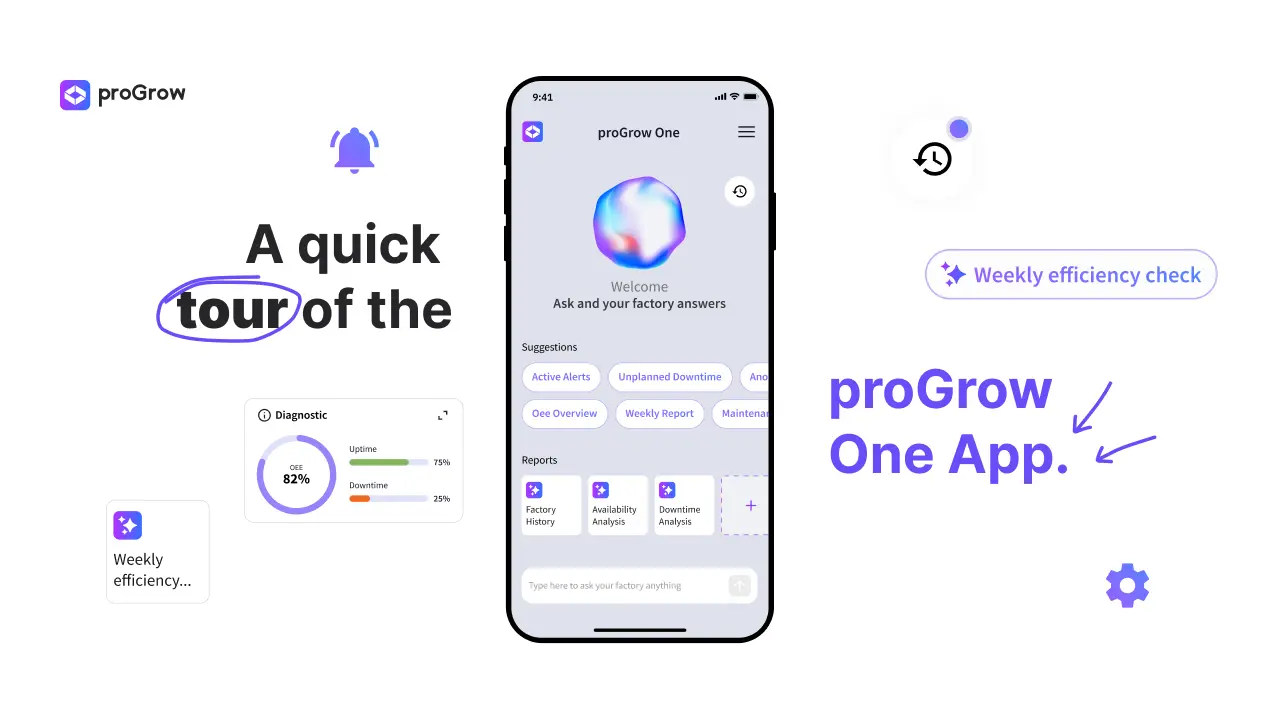
A quick tour of the proGrow One App
Learn how the proGrow One App digitalizes your factory, offering real-time OEE tracking, machine monitoring, and AI insights.