In the industrial sector, we constantly hear that we need to be "more efficient." However, efficiency remains an abstract concept until we place a currency symbol (€) in front of it.
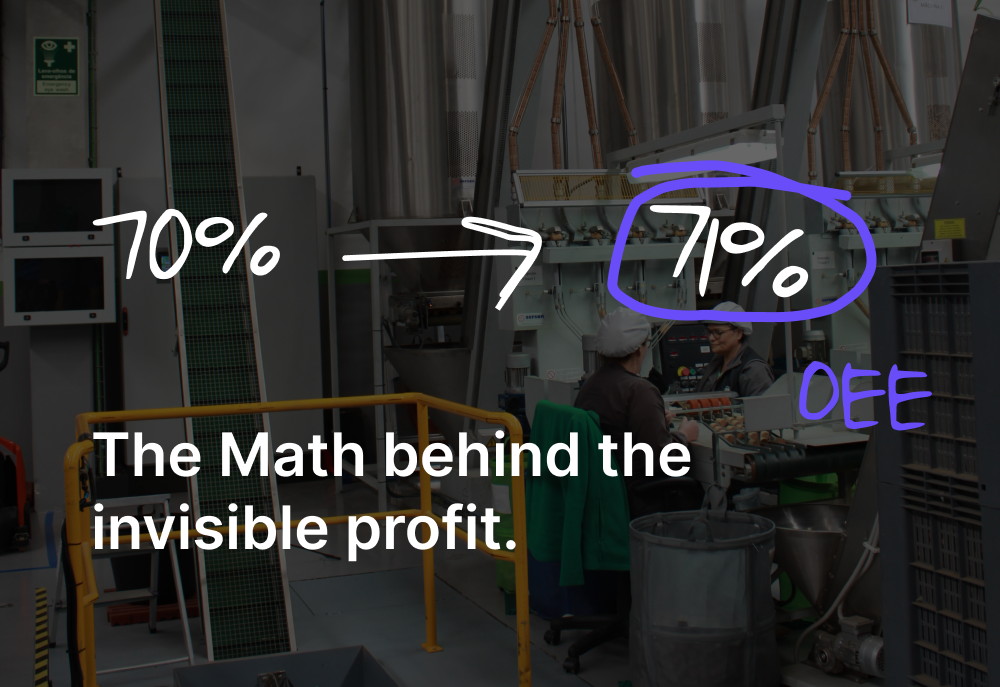
If you were told that by increasing your OEE by just 1 percentage point (p.p.), you could pay for the annual investment in new software or even cover the maintenance costs of an entire production line, would you believe it?
Let’s do the math.
The direct impact on your EBITDA
OEE (Overall Equipment Effectiveness) is the gold standard for measuring machine productivity. It tells us what percentage of manufacturing time is truly productive.
To quantify the real value of just a 1 p.p. improvement, let’s analyze the numbers from a real production unit:
• Annual Turnover: €5,000,000
• Current OEE: 70%
• Contribution Margin: 40% (the value remaining after deducting variable costs, such as raw materials and energy).
When we increase efficiency, we are directly impacting EBITDA (Earnings Before Interest, Taxes, Depreciation, and Amortization).
Assuming fixed costs are already covered by the current 70% efficiency, every gain in efficiency translates almost entirely into net profitability.
In this scenario, a 1 p.p. increase in OEE is not just a technical detail; it represents an increment of X € in billing capacity or a direct optimization of the margin.
How does this value materialize in your financial balance sheet?
Let’s break down the calculation into 3 simple steps:
Step 1: Calculate the value of each percentage point of total capacity
If at 70% efficiency you achieve a turnover of €5,000,000, each p.p. of total capacity is worth:
5.000.000 € * 1 / 70= 71.428 €
Step 2: The real impact of rising to 71%
By increasing your OEE to 71%, you are unlocking a productive capacity equivalent to €71,428 without needing to increase your infrastructure. This gain can be utilized in two ways, both with a direct business impact:
• To increase production: You can deliver an additional €71,428 in turnover without hiring a single extra operator or investing in new machinery.
• To maintain current volume: You can produce the exact same volume in much less time. This allows you, for example, to reduce shifts, eliminate overtime, and lower your operational costs.
Step 3: Direct impact on Profit (EBITDA)
Since fixed costs (rent, salaries) are already paid for by the first 70% of efficiency, this additional p.p. has a much higher profitability and only needs to cover its own variable costs (the 60% for raw materials and energy).
Thus, the remainder (the 40% Contribution Margin) is converted almost entirely into operational profit:
71.428 € * 0,40 = 28.571 €
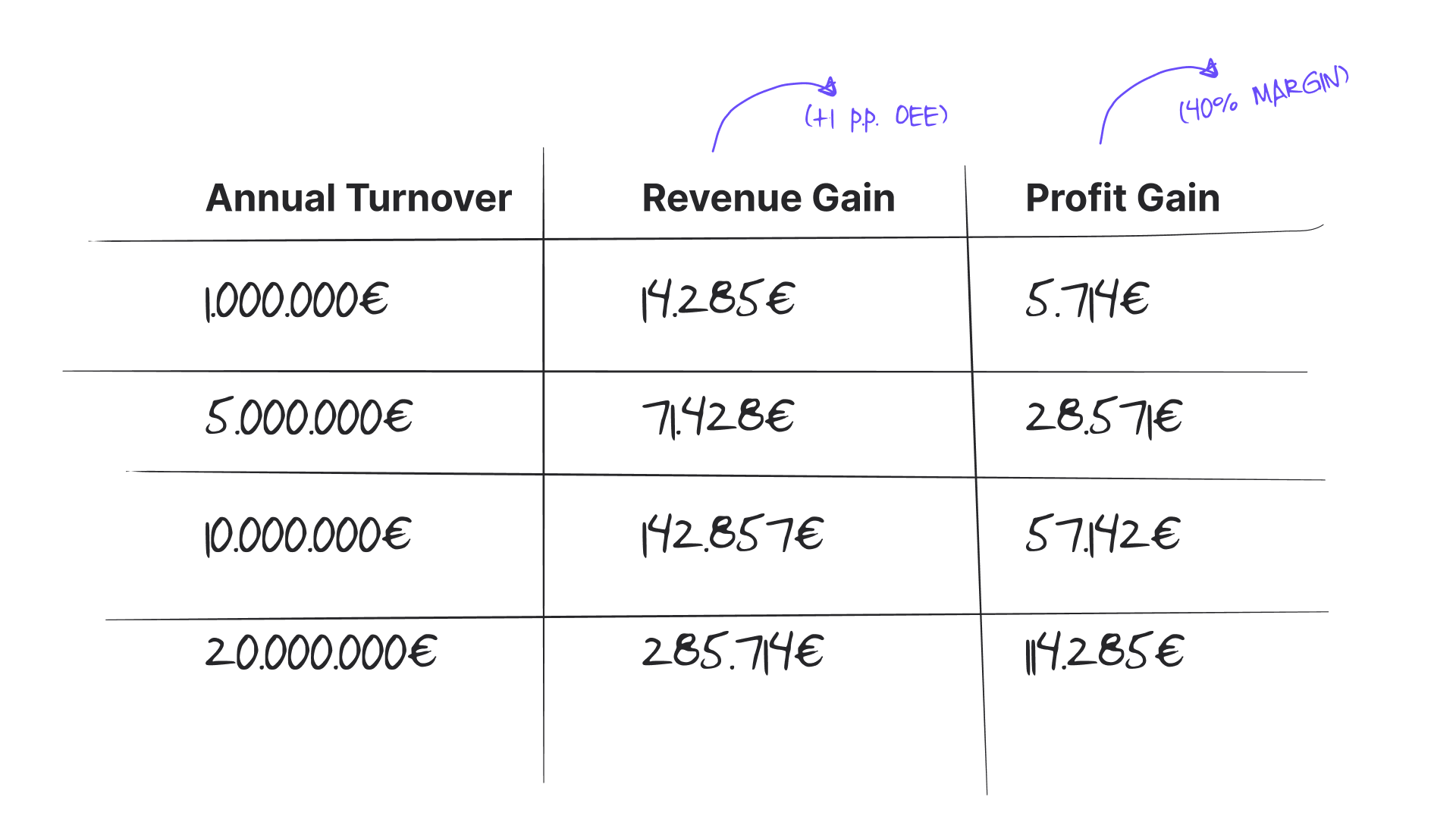
Impact Table: The value of 1 p.p. according to your turnover
See how much money you are "losing", or rather, not earning, by not optimizing your production by just 1 percentage point:
Where can you recover this 1 p.p.?
Increasing productivity doesn’t mean "running faster"; it means eliminating "invisible waste":
• Reducing micro-stops: Those 1-minute failures that occur 15 times per shift.
• Accelerating setups: Moving from 30 to 25 minutes for mold or tool changes.
• Quality at the first attempt: Preventing 1% of parts from going to scrap.
Sounds too good to be true?
Don’t take our word for it. Experience it yourself.
proGrow’s Chat AI helps you identify which data to measure, where invisible waste is hiding, and which bottlenecks to tackle first.
Just ask and your factory answers. Try it: "What were the top 3 causes of micro-stops on Machine 1 last week?" and get immediate insights.
👉 Download the app and start talking to your factory today.